Strong bearish −653 sourcesnasdaq · correction · ai · selloff
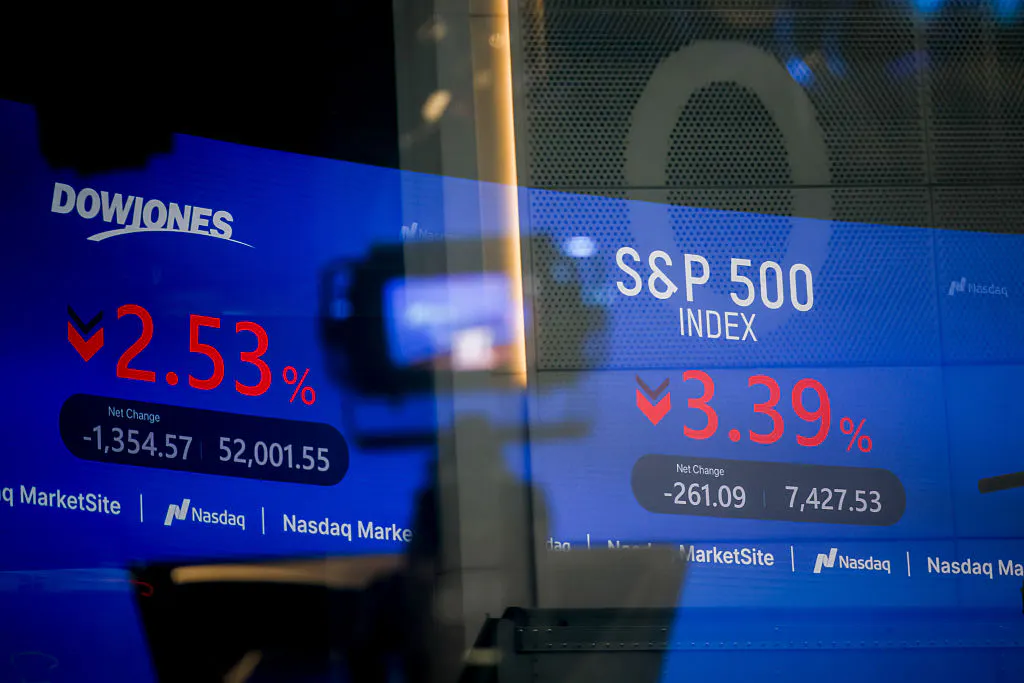
The S&P 500 shed $2.9 trillion in market value and Nasdaq companies lost $2.5 trillion in a single day—both record drops—after Democrats swept midterm elections, sparking investor panic over potential regulatory constraints on data center expansion and AI infrastructure investment. The Nasdaq plunged 5.1% into correction territory as markets repriced expectations for a slower AI capex cycle under Democratic governance.
Key points
Market impact. Tech titans including Elon Musk lost $80 billion in personal wealth during the rout, with nine tech billionaires collectively shedding $150 billion. AI and semiconductor stocks bore the brunt as investors fled on concerns that Democratic opposition to data center projects could choke off the infrastructure needed to sustain AI scaling.
Broader implications. The selloff exposes a critical vulnerability in AI's investment thesis: regulatory risk. Democratic control of Congress threatens to slow the massive capex buildout that underpins AI company valuations, potentially reshaping the sector's growth trajectory and forcing a repricing of trillion-dollar AI valuations.
Neutral +73 sourcesdata centers · google · crusoe · ai infrastructure
Crusoe Energy sold its troubled Wyoming data center project to Google, signaling the challenges of developing massive AI infrastructure amid mounting political opposition. The deal comes as voters made their distaste for data centers clear, with heavy civil contractor Tutor Perini reporting $200 billion in potential bids but almost none for data center work.
Key points
Market impact. The transaction underscores that only mega-cap tech firms with balance sheet strength can absorb data center development risk; smaller players face project failures. This consolidation dynamic favors Google, Microsoft, and Amazon while raising barriers for competitors seeking to build independent AI infrastructure.
Broader implications. Political backlash against data centers is now a material constraint on AI capex. Communities and Democratic lawmakers are blocking projects on energy and land-use grounds, forcing AI giants to acquire existing assets rather than greenfield development—a structural shift that could slow the pace of AI scaling.
Sources (3)TechCrunch, CBS Money Watch, Construction Dive
Bearish −353 sourcestesla · cybertruck · production · elon musk
Tesla CEO Elon Musk announced the company will wind down Cybertruck production in mid-2027 to prioritize Cybercab autonomous vehicle manufacturing. The decision reflects insufficient demand for the polarizing stainless steel truck, which has failed to gain traction with mainstream buyers despite years of hype.
Key points
Market impact. The move signals Tesla's strategic pivot away from the Cybertruck as a flagship product and toward autonomous robotaxis, betting the Cybercab will drive higher margins and growth. It also reflects broader EV market weakness as consumer demand for electric vehicles softens amid rising interest rates and economic uncertainty.
Broader implications. Tesla's retreat from the Cybertruck validates skeptics who questioned the vehicle's commercial viability and underscores the company's willingness to abandon low-demand products. The shift to autonomous vehicles represents a higher-risk bet on technology that remains unproven at scale.
Sources (3)NPR Business, ABC News, New York Times Business
The U.S. economy added 165,000 jobs in October, far exceeding the 59,000 expected, with unemployment declining to 4.1% from 4.2%. Professional and business services drove the gain with 70,000 new positions, signaling resilience in the labor market despite broader market turmoil.
Key points
Market impact. The stronger-than-expected jobs report provided a counterweight to Thursday's AI-driven selloff, offering evidence that the broader economy remains intact. However, the data complicates the Federal Reserve's rate-cut calculus and may limit near-term equity upside if it signals sustained inflation pressure.
Broader implications. A resilient labor market reduces recession risk but also suggests the Fed may need to maintain higher rates longer than markets hope. This dynamic creates tension between equity valuations and macro fundamentals, particularly as AI capex uncertainty weighs on growth expectations.
Sources (3)WSJ Economy, CNBC Economy, CBS Money Watch
Prediction market traders on Kalshi slashed odds of an Anthropic IPO announcement before December following the post-election AI selloff and Democratic sweep. Investors are now demanding more attractive valuations to commit capital, with some questioning whether the recently discussed IPO timeline remains viable.
Key points
Market impact. The delay signals that AI company IPO windows are closing as public market sentiment deteriorates. Anthropic's valuation expectations may need to reset downward, and the company may face pressure to demonstrate profitability or near-term revenue growth to justify a public offering in a hostile environment.
Broader implications. The IPO delay reflects broader concerns about AI's regulatory and political headwinds. If Anthropic postpones its offering, it signals that even well-capitalized AI startups face market timing challenges and that the AI funding boom may be entering a more selective phase.
Sources (2)CNBC Top Stories, New York Post Business
Toyota's stock soared after the company raised its annual earnings outlook and announced an $89 billion shareholder return plan, driven by surging hybrid vehicle sales as fuel costs spike following the Iran war. The automaker has benefited from its long-standing focus on petrol-electric hybrids as EV demand slows amid rising interest rates and consumer hesitation.
Key points
Market impact. Toyota's outperformance validates the hybrid strategy over pure EV bets and signals a structural shift in consumer preferences toward fuel efficiency over electrification. The company's ability to scale hybrid production and capture market share from EV-focused competitors positions it as a near-term beneficiary of energy volatility and economic uncertainty.
Broader implications. Toyota's success challenges the narrative that EVs are inevitable and suggests that hybrid technology remains economically superior for many consumers. Political shifts in Washington toward skepticism of EV mandates may further accelerate hybrid adoption, extending Toyota's competitive advantage.
Sources (3)CNBC Top Stories, New York Times Business, Motor1
Paraguay's President Santiago Peña was impeached and removed from office Friday after the collapse of Ueno digital bank froze millions of citizens' savings. Peña had authorized Ueno to drastically expand operations before the lender's failure, and faced continuing scrutiny over his former ties to the bank's parent company.
Key points
Market impact. The political crisis threatens Paraguay's macroeconomic stability and investor confidence in the nation's financial system. The removal signals governance breakdown and raises questions about regulatory oversight of fintech and digital banking operations in emerging markets.
Broader implications. The crisis may jeopardize Paraguay's uranium development ambitions and broader foreign investment. It underscores the risks of rapid fintech expansion in emerging markets without adequate regulatory guardrails and demonstrates how digital banking failures can trigger political upheaval.
Sources (3)New York Times Business, Northern Miner, The Guardian World News
Neutral +123 sourcesfox · roku · acquisition · streaming
Fox Corp completed its $22 billion acquisition of streaming platform Roku on Friday, well ahead of schedule despite DOJ scrutiny. The deal consolidates Fox's streaming assets and positions the combined entity as a major competitor in free ad-supported television (FAST).
Key points
Market impact. The acquisition strengthens Fox's ability to compete with Netflix, Disney, and Amazon in streaming and advertising. The combined company gains scale in FAST content distribution and advertising technology, potentially improving margins and reducing dependence on traditional linear TV.
Broader implications. The deal signals continued consolidation in streaming as legacy media companies seek scale and advertising revenue. It validates the FAST model as a viable alternative to subscription-based streaming and positions Fox to capture advertising dollars migrating from linear television.
Sources (3)New York Post Business, TechCrunch, Business Insider
Bullish +253 sourcesspacex · starlink · qualcomm · mobile
SpaceX signed a multiyear deal with Qualcomm to develop base station technology for its Starlink Mobile cellular network, marking a major step toward launching a satellite-based mobile service. The partnership leverages Qualcomm's 5G expertise to accelerate Starlink's challenge to traditional telecom carriers.
Key points
Market impact. The deal provides Qualcomm a growth vector outside smartphone chipsets and positions the company to capture share in satellite communications infrastructure. Qualcomm's stock gained on the announcement as investors recognized the company's expansion into high-growth markets beyond traditional handset semiconductors.
Sources (3)Market Watch, The Verge, CNBC Top Stories